What Is Caga Tió? Barcelona’s Strangest Christmas Tradition
What the Christmas log means, how families celebrate, where to find it and the Catalan and Spanish words to know.
 By Camila · Published 4 November 2026
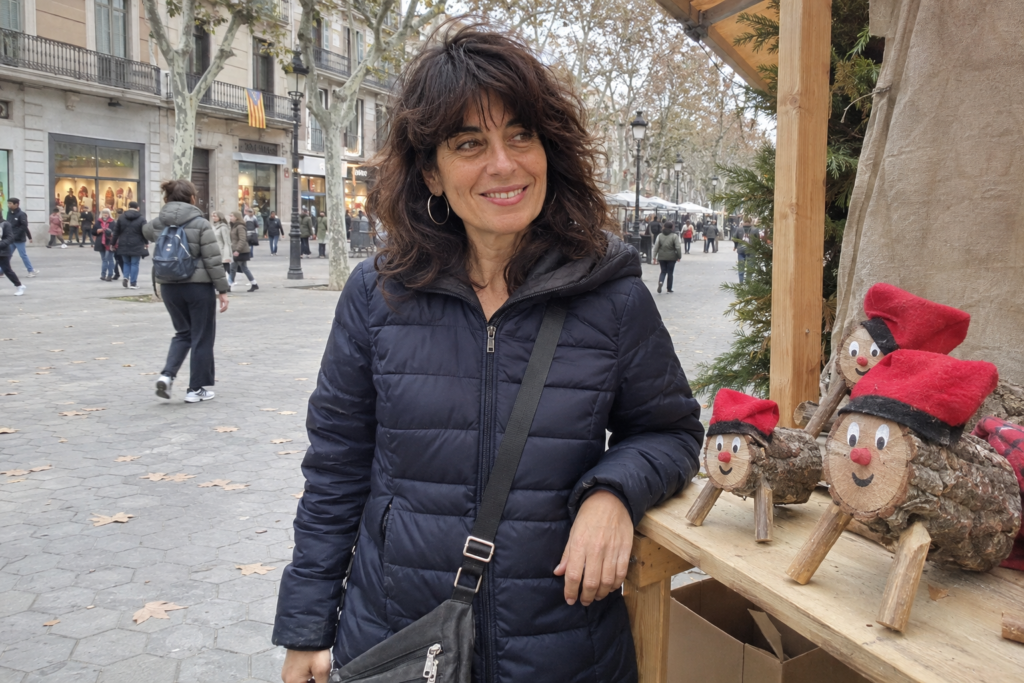
There is a smiling log at the Christmas market. It has a red hat, two little legs and the expression of someone who has absolutely nothing to worry about.
You would be wrong about that last part.
This is the tió de Nadal, the Catalan Christmas log. In the days before Christmas, children feed it and keep it warm under a blanket. Then, on Christmas Eve or Christmas Day, they sing, tap it with sticks and discover the sweets or small presents it has supposedly “pooped”. Yes, that is the tradition. You have understood perfectly.
You will often see it called Caga Tió in English guides. But there is a small language distinction worth knowing: the log is the tió; caga, tió is what the children tell it to do. We will get to that. Even a Christmas log can offer us a language lesson.
I’m Camila, a native Spanish speaker and former host teacher living in Barcelona. I now help learners explore their course options, and I write about the language and culture they will encounter along the way. For me, this is exactly the sort of tradition worth understanding before you arrive: you notice something unexpected, ask a question and suddenly have a reason to talk to someone.
Here is what the tió means, how the celebration works and how to explore it respectfully during a Christmas visit to Barcelona.
In this guide
- The essential facts
- What does Caga Tió mean?
- How the tió tradition works
- What is the Caga Tió song?
- Where does the tradition come from?
- Is the tió the same as the caganer?
- Where to find the tió in Barcelona
- Joining in without feeling awkward
- Useful Catalan and Spanish Christmas words
- A short Spanish conversation to practise
- Questions visitors often ask
- Take one question with you
The essential facts
| Question | Quick answer |
|---|---|
| What is it? | A Christmas log associated with a Catalan gift-giving tradition. |
| What is its name? | Tió or tió de Nadal. |
| What does caga, tió mean? | Roughly, “Poop, log!” It is an instruction, not the log’s proper name. |
| What do children do? | Care for it before Christmas, then sing and tap it with sticks to make it produce treats. |
| When does it happen? | Commonly Christmas Eve or Christmas Day; public activities can take place earlier. |
| Is it the same as the caganer? | No. The caganer is a separate figure associated with the nativity scene. |
Family customs vary. Think of this as an introduction to the tradition, rather than a set of instructions every household follows.
What does Caga Tió mean?
In Catalan, tió refers to a log or piece of wood, and Nadal means Christmas. So tió de Nadal is the Christmas log.
The phrase caga, tió addresses the log and tells it to poop. That wording comes from the songs sung during the activity. The traditional expression for taking part is fer cagar el tió. The Diputació de Barcelona’s language service distinguishes the character’s name from the action and explains how the two became mixed together in the name cagatió.
If you searched for “Caga Tió Barcelona”, you have found the right tradition. When talking about the little wooden character itself, though, tió is the useful word to remember.
One more detail for Spanish learners: Catalan tió and Spanish tío are different words. Spanish tío means “uncle” and can also be used informally to refer to a man or address someone, depending on the context. The Christmas log is not somebody’s uncle. Notice where the written accent goes, too.
You do not need a grammar lecture before visiting a market. But that tiny accent can save you a fairly confusing conversation.
How the tió tradition works
The attraction is not only the moment when the presents appear. There is a little story to participate in beforehand.
The log arrives
The tió joins the household in the weeks before Christmas, often around 8 December. Some families arrange for children to find it; others bring out their familiar log. There is no single arrival story that every family must use.
The version you are likely to recognise has a painted face, small front legs and a barretina, the traditional Catalan cap. The face makes it look less like firewood and more like a guest who expects to be looked after.
Children look after it
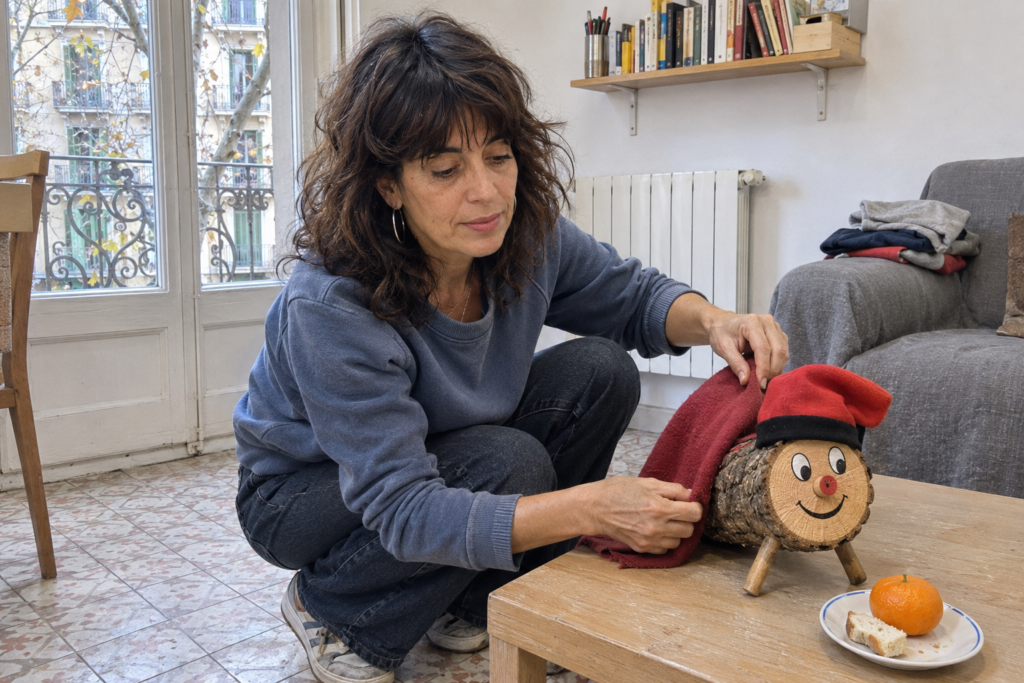
Children leave food for the tió and cover it with a blanket. In the story, this care helps prepare it for its Christmas task. Different households choose their own details: what to offer, where it stays and how much ceremony surrounds its arrival.
If you are explaining this to a child, keep the story simple: “We look after the log, and at Christmas it gives us a surprise.” You can let the family hosting you supply the rest. There is no need to become the visiting expert on somebody else’s Christmas.
The song and sticks come out
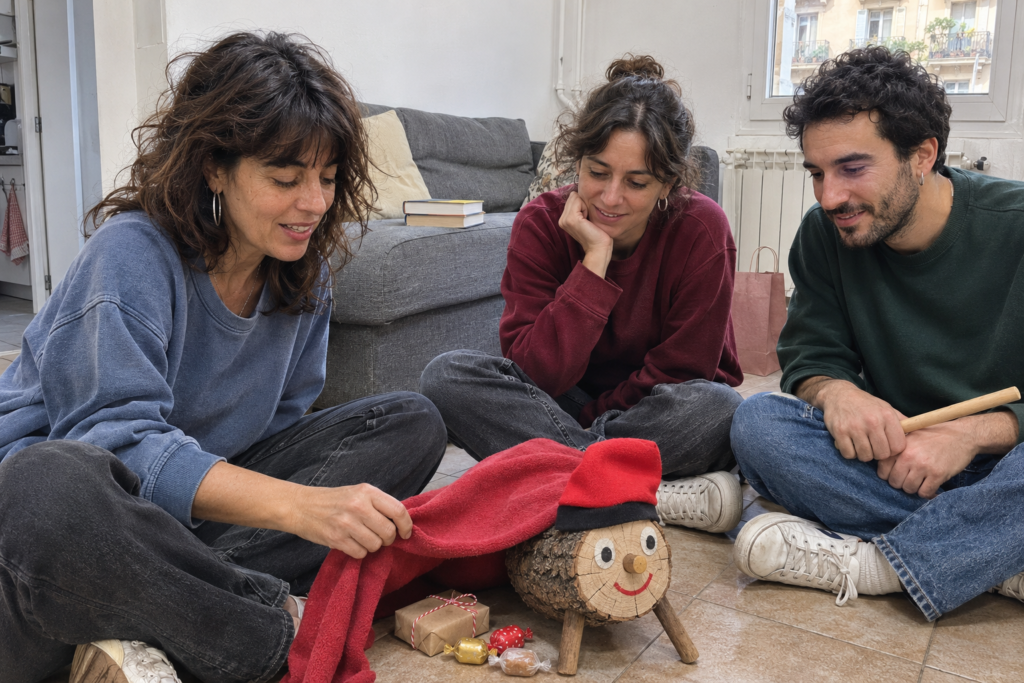
At the celebration, children sing and strike the log with sticks. Afterwards, the blanket is lifted to reveal what it has produced. Sweets and small gifts are associated with the custom. The exact timing and family routine differ.
For visitors joining a household celebration, my advice is to watch a round first. You will see where to stand, when to sing and how the adults organise it. If you are arranging an activity yourself, use gentle taps and give each child enough space.
The important skill is joining in. There is no prize for hitting a log particularly hard.
What is the Caga Tió song?
The singing is part of the ritual, not background music. It gives the group a shared rhythm and tells the tió what everyone is hoping to receive.
There are different versions of the song. One familiar version asks for almonds and torró and rejects sardines for being too salty. Barcelona’s tourism organisation describes this version in its introduction to local Christmas customs.
If you are invited to join, ask your hosts which version they use. Learning a short refrain with them is much more useful than arriving with a long set of lyrics and announcing that everybody else has them wrong.
For a Spanish-speaking conversation, try:
¿Me enseñáis la canción?
Will you teach me the song?
¿Podéis repetirlo más despacio?
Can you repeat it more slowly?
These use the informal plural forms common in Spain when addressing a group. If you are speaking to one person, use ¿Me enseñas la canción? and ¿Puedes repetirlo más despacio?
The song itself is Catalan. Asking about it in Spanish does not turn it into a Spanish song; it gives you a way to learn about the culture through conversation.
Where does the tradition come from?
The smiling face makes the tió look like a character designed for a toy shop. Its background is older and more closely connected with the home.
The Consorci per a la Normalització Lingüística describes its relationship with the hearth: wood provided heat, light and the means to cook. Caring for the log expressed the importance of the tree and nature’s continuing generosity.
The Generalitat’s Department of Culture places the tió within a broader family of European winter customs. Its interpretation connects the apparently lifeless wood producing gifts with renewal and abundance. It also explains that the human-like face is a later development, rather than an essential feature of the earliest form of the custom.
It is worth being careful with neat origin stories. You may read confident claims about exactly when the tradition began. Barcelona broadcaster betevé, drawing on folklorist Amadeu Carbó, notes that its precise origin is unknown. Older winter symbolism helps explain the tradition, but it does not give us a securely documented birthday for the modern Christmas character.
For me, that history makes the custom more interesting. The joke is easy to notice. The relationship between winter, care and the household takes a little longer to see.
Is the tió the same as the caganer?
No, although it is an understandable mix-up.
The tió is the log involved in the gift-giving activity. The caganer is a figurine shown squatting to relieve itself, traditionally placed within a nativity scene, or pessebre. The association Amics del Caganer describes its customary position in a discreet corner and the game of looking for it among the other figures.
| Tió de Nadal | Caganer |
|---|---|
| A log, often with a smiling face | A small figurine of a person |
| Part of an activity involving songs and treats | Part of the nativity-scene tradition |
| Children care for it before the celebration | Children may search for it within the display |
Both can surprise a visitor. They are still separate traditions, with different roles. Once you know that, a Christmas market becomes a little easier to understand.
Where to find the tió in Barcelona
Start with the Fira de Santa Llúcia
The Fira de Santa Llúcia, on Avinguda de la Catedral, is a useful place to look for traditional Christmas objects. Catalunya’s official tourism website lists tió logs among the products sold there, alongside nativity figures and other seasonal decorations.
Be careful with the location: this is the area in front of Barcelona Cathedral, not the Sagrada Família. Put the full market name into your map before setting off.
I would give yourself time to browse before buying. Look at the size, the finish and how you would carry it home. A souvenir is less charming when it takes up the space you had reserved for your shoes.
You could ask a seller:
¿Tenéis uno más pequeño?
Do you have a smaller one?
¿Está hecho a mano?
Is it handmade?
¿Dónde se ha hecho?
Where was it made?
These are questions to ask, rather than qualities to assume. Different stalls and objects may have different answers.
Check for organised activities
The fair’s organiser has run a tió gegant, or giant tió, for children. Its published programme includes age restrictions and activity times. Those details need checking for the specific edition you plan to attend.
As checked on 4 November 2026, the organiser’s activity page still contains programme text explicitly referring to 2025, alongside older material and a request for 2026 sponsorship. I could not establish a confirmed 2026 giant-tió timetable from that page. Check the organiser’s activities page for the current programme before planning around a particular session.
When assessing an event listing, check the year as well as the day and month. Then check the age range, booking requirements, meeting point and whether watching is possible if you are not participating.
This is particularly useful if you are travelling with children. A market visit and a place in a scheduled activity are two different things.
Joining in without feeling awkward
You do not need to know every custom before accepting an invitation. A little curiosity is enough.
- Ask how that household celebrates. “How do you do it here?” leaves room for their version. “But I read that you have to do it this way” usually closes the conversation rather quickly.
- Follow the parents’ lead around children. If they are keeping the story magical, there is no reason to explain the logistics of the hidden presents.
- Check before photographing people. A picture of a market display is different from a close-up of someone else’s child participating.
- Let the custom be funny without making people the joke. You can enjoy the absurdity of a gift-producing log and still appreciate that it belongs to somebody’s family memories.
And if the singing goes faster than you can follow, smile and listen. Understanding everything immediately is not an entrance requirement.
Useful Catalan and Spanish Christmas words
Because this is a Spanish-learning website, I want to make the language labels especially clear. Some of the words you encounter around this tradition are Catalan. Learning their Spanish equivalents helps you talk about what you see without confusing the two languages.
| English | Catalan | Spanish |
|---|---|---|
| Christmas | Nadal | Navidad |
| Merry Christmas | Bon Nadal | Feliz Navidad |
| Christmas Eve | Nit de Nadal | Nochebuena |
| A blanket | una manta | una manta |
| A gift | un regal | un regalo |
| A song | una cançó | una canción |
| A stick | un bastó | un palo |
| A nativity scene | un pessebre | un belén |
| Nougat / a traditional Christmas confection | torró | turrón |
In Spanish conversation, you can keep the cultural name tió and explain it as un tronco de Navidad, a Christmas log. You do not have to translate every local name to have a clear conversation.
A short Spanish conversation to practise
This is an example you can adapt, not a transcript of a real encounter.
Visitante: Perdona, ¿qué es ese tronco?
Excuse me, what is that log?
Anfitriona: Es el tió. Es una tradición navideña catalana.
It’s the tió. It’s a Catalan Christmas tradition.
Visitante: ¿Y cómo se celebra?
And how do you celebrate it?
Anfitriona: Los niños le cantan y le dan golpes con un palo. Después encuentran regalos debajo de la manta.
The children sing to it and hit it with a stick. Afterwards, they find gifts under the blanket.
Visitante: Eso no lo había visto nunca. ¿Puedo mirar?
I had never seen that before. Can I watch?
For beginners, the most reusable sentence is ¿Qué es eso? — “What is that?” You can use it for an unfamiliar food, a decoration or something you spot in a shop window. Three words can open a much longer conversation.
For learners ready for a little more, notice le cantan: they sing to it. The small word le tells us who receives the singing. In this particular conversation, the recipient happens to be made of wood.
Questions visitors often ask
Is this a tradition throughout Spain?
It is especially associated with Catalonia, and Barcelona is one place to encounter it. Avoid describing it as something every Spanish household does. Regional traditions and family choices matter.
Must you celebrate on 24 December?
No single timetable covers every household. Christmas Eve and Christmas Day are both associated with the activity, while organised events may take place on other dates during the festive season. Ask your hosts or consult the event programme.
Can adults enjoy it?
Of course. You can learn about it, watch when appropriate and appreciate the craft of the logs on sale. Participation in a public children’s activity is a separate matter: check its rules and leave children their turn.
Do I need to speak Catalan to understand it?
You can understand the basic activity without speaking Catalan. Learning the name, a greeting and a little of the song makes the experience richer. If you need an explanation, ask whether someone can help in a language you share.
Should I call it Caga Tió or tió de Nadal?
Use tió or tió de Nadal for the log. “Caga Tió” is a widely encountered search term, but it comes from the instruction addressed to the character. The distinction is a small way to show you have taken an interest in the language behind the custom.
Take one question with you
If you visit Barcelona at Christmas, you do not need to memorise this entire guide. Recognise the tió, understand what the children are doing and take one question with you: ¿Cómo lo celebráis vosotros? — “How do you celebrate it?”
That is the kind of learning I want this website to encourage. Enough knowledge to notice something, enough language to ask about it and enough curiosity to listen to the answer.
If your trip will also include Spanish classes, you can explore the course options on Learn Spanish in Barcelona or get in touch about your goals. I work as a course agent now, and I can help you consider how classes might fit alongside the city you have come to experience.
And should a small log make it into your suitcase, at least you will be able to explain it when you get home.